Starting Strength Training After 50: How to Begin Safely and What the First Months Look Like
Maybe you've been meaning to start for years. Maybe a doctor mentioned bone density or blood sugar, or you noticed that getting off the floor takes more effort than it used to. Then the doubts show up: Am I too old to start? What if I get hurt? Where do I even begin?
Here is the short answer from the research: adults in their 50s, 60s, 70s and beyond respond well to strength training. Done sensibly, it is safe, and the early months are often the most encouraging part.
Why it's worth starting now
Muscle and strength decline with age, and strength drops faster than muscle size. A 2012 review in Frontiers in Physiology found that, in studies that measured both in the same people, strength was lost 2 to 5 times faster than muscle mass. It also found that loss of strength was a more consistent risk factor for disability and death than loss of muscle mass. (We covered this in more detail in our post on strength after 40.)
The good news is that this is one of the most responsive systems in the body:
A 2009 Cochrane review pooled 121 trials with 6,700 older adults. Progressive resistance training had a large positive effect on muscle strength. It also improved getting up from a chair, and produced a modest improvement in walking speed.
A 2011 meta-analysis of 49 studies in adults aged 50 and older found resistance training added about 1.1 kg (2.4 lb) of lean body mass on average. Higher-volume programs produced bigger gains.
The American College of Sports Medicine's position stand on exercise for older adults says that while no amount of activity stops biological aging, regular exercise can limit the effects of an inactive lifestyle and help prevent chronic disease and disability. It recommends that older adults include aerobic, muscle-strengthening and flexibility exercise.
Is it safe?
This is the question we hear most, so here is what the evidence actually says.
The Cochrane review looked closely at side effects. Serious adverse events were rare, and none of the serious events reported were directly linked to the exercise program. The complaints that did come up were mostly muscle soreness and joint pain. The authors also noted that adverse events were often poorly recorded, so some caution is reasonable, especially for people with medical conditions.
In 2019 the National Strength and Conditioning Association (NSCA) published a position statement on resistance training for older adults. It calls resistance training "a powerful intervention" against the loss of strength and muscle, and one of its stated goals is to reduce the fears and other barriers that keep older adults from starting.
Should you check with your doctor first? The American College of Sports Medicine's 2015 screening guidance bases this on three things:
How active you are right now
Whether you have signs or symptoms of, or a known diagnosis of, heart, metabolic (such as diabetes) or kidney disease
How hard you plan to exercise
If you've been inactive and have any of those conditions or symptoms, such as chest discomfort, unusual shortness of breath or dizziness, talk with your healthcare provider before you start. The same goes for a recent surgery, a joint replacement, or a bone density diagnosis. For most healthy adults, the ACSM's message is that regular activity is important for everyone, and that screening should not become an unnecessary barrier.
What the first months usually look like
Every body is different, but research and coaching experience point to a fairly predictable pattern.
Weeks 1 to 4: learning the movements
Early strength gains come mostly from your nervous system learning to use the muscle you already have. A classic 1979 study by Moritani and deVries found that in the first few weeks of training, most of the strength increase came from these "neural" changes. After about 3 to 5 weeks, muscle growth began to play the bigger role. That study was small and done in young adults, so treat the timeline as a rough guide, but the principle holds: you'll often feel stronger before you look any different.
What to expect:
Learning the basic patterns: squatting (sitting to a box or bench), hinging (picking something up from the floor), pushing, pulling, carrying, and getting up and down from the floor
Light to moderate loads, with plenty left in the tank at the end of each set
Some muscle soreness a day or two after the first sessions. That's normal and usually fades as your body adapts. Sharp or joint pain is different, and worth telling your coach about.
Weeks 5 to 12: building
Loads begin to go up gradually. The research on older adults consistently points to progressive training, where the challenge grows over time, as the thing that drives results.
Everyday tasks start to feel easier: stairs, groceries, getting out of a low chair.
Muscle gains begin to add up, though they're slower to show on the outside than strength gains.
Month 3 and beyond: making it a habit
By now you'll have a sense of what your body likes, what it needs extra time on, and how it recovers. The meta-analysis evidence suggests that more training volume over time brings more lean mass, so the goal becomes staying consistent and continuing to progress.
How much and how often
The CDC recommends that adults do muscle-strengthening activity at least 2 days a week, working all major muscle groups (legs, hips, back, abdomen, chest, shoulders and arms), plus 150 minutes a week of moderate aerobic activity. Most Cochrane trials trained two to three times a week.
Five habits that help beginners succeed
Start lighter than you think. You can always add weight next week. Starting too heavy is the most common reason beginners get sore, discouraged or hurt.
Learn the movement before you load it. Good positions first, then weight.
Get coaching, at least at first. A 2017 meta-analysis found that supervised balance and strength training produced greater strength and balance gains in older adults than unsupervised programs.
Eat enough protein. The PROT-AGE Study Group recommends at least 1.0 to 1.2 g of protein per kilogram of body weight per day for adults over 65, and at least 1.2 g/kg for active adults. People with severe kidney disease are an exception and should talk with their provider. (See our post on protein for details.)
Track more than weight. Strength, how well you move, and body composition tell you far more about progress than the bathroom scale.
How we start new members at Peak Life Fitness
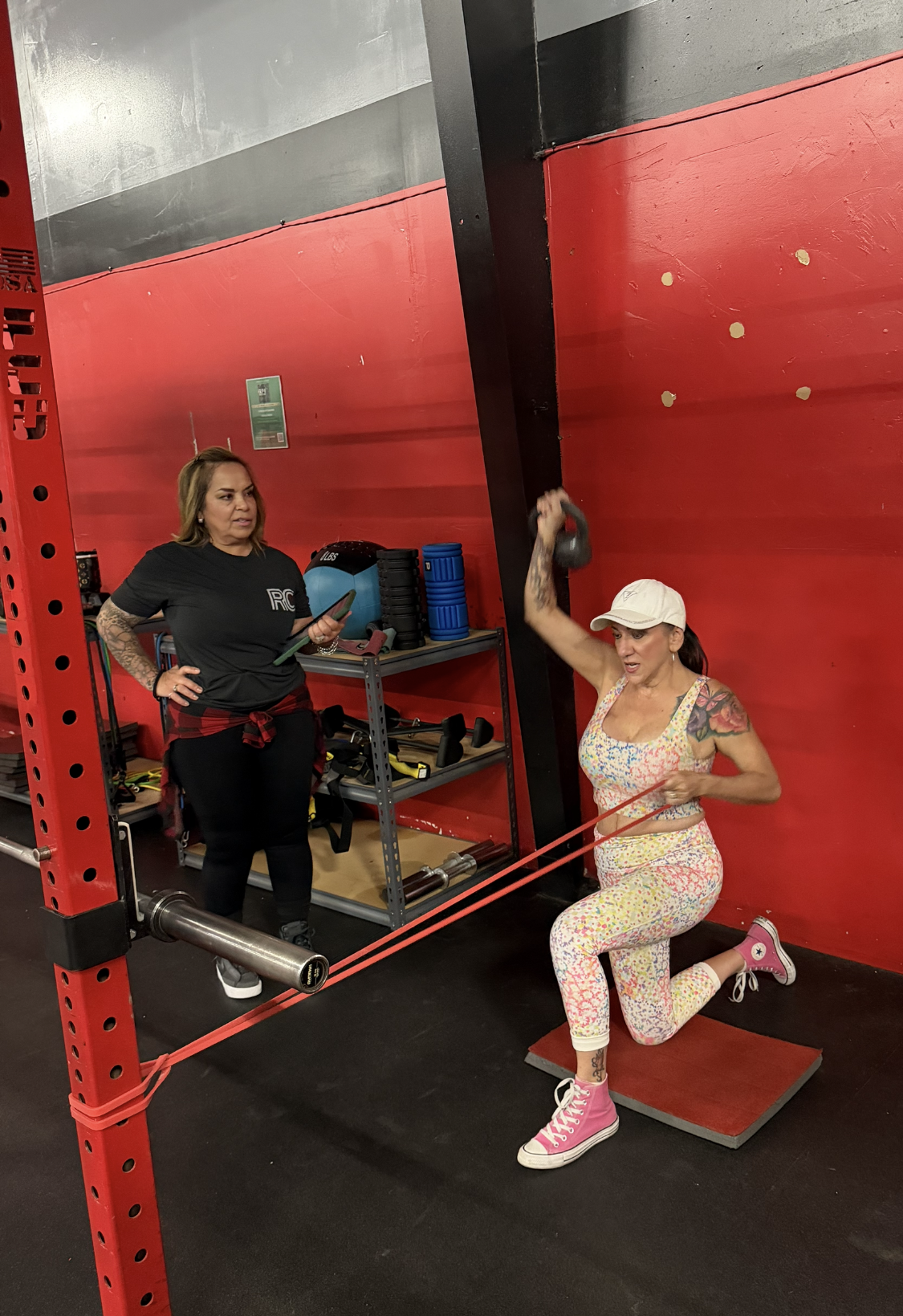
Our 12-week Muscle Protection Program is built for people who want a clear, structured start. It combines strength training, nutrition, body-composition tracking with InBody scans, and a focus on everyday function, like getting up from the floor and carrying what you need to carry. Every PLF program also includes unlimited coach-led Large Group Training and unlimited Semi-Private Strength Training. That means you have a coach with you while you learn, and you're surrounded by people who started exactly where you are.
Ready to take the first step?
You don't need to be in shape to start. You just need a starting point that fits you. Schedule a free phone consultation with Jeff or Michelle to talk through your goals, or learn more about our Muscle Protection Program.
Frequently Asked Questions
Is 50 or 60 too old to start lifting weights? No. A Cochrane review of 121 trials in older adults found strength training had a large positive effect on strength, and many studies include people in their 70s and 80s.
How soon will I notice results? Many people feel stronger within the first few weeks, mainly because the nervous system learns to use muscle more effectively. Visible muscle changes take longer, typically building over the following months.
Is it normal to be sore after the first sessions? Mild muscle soreness for a day or two is common when you start. Research reviews list soreness and joint aches as the most commonly reported complaints. Sharp pain or pain in a joint should be reported to your coach and, if it persists, your healthcare provider.
Do I need to see a doctor before I start? ACSM guidance says it depends on your current activity level, any signs or symptoms or known heart, metabolic or kidney disease, and how hard you plan to exercise. If you're unsure, check with your healthcare provider.
How many days a week should a beginner train? The CDC recommends muscle-strengthening activity at least 2 days a week. Most research programs in older adults used two to three sessions a week.
Sources
Mitchell WK, et al. Sarcopenia, dynapenia, and the impact of advancing age on human skeletal muscle size and strength; a quantitative review. Front Physiol. 2012;3:260. https://doi.org/10.3389/fphys.2012.00260 (PubMed: https://pubmed.ncbi.nlm.nih.gov/22934016/)
Liu CJ, Latham NK. Progressive resistance strength training for improving physical function in older adults. Cochrane Database Syst Rev. 2009;(3):CD002759. https://doi.org/10.1002/14651858.CD002759.pub2 (PubMed: https://pubmed.ncbi.nlm.nih.gov/19588334/)
Peterson MD, Sen A, Gordon PM. Influence of resistance exercise on lean body mass in aging adults: a meta-analysis. Med Sci Sports Exerc. 2011;43(2):249-258. https://doi.org/10.1249/MSS.0b013e3181eb6265 (PubMed: https://pubmed.ncbi.nlm.nih.gov/20543750/)
American College of Sports Medicine; Chodzko-Zajko WJ, et al. American College of Sports Medicine position stand. Exercise and physical activity for older adults. Med Sci Sports Exerc. 2009;41(7):1510-1530. https://doi.org/10.1249/MSS.0b013e3181a0c95c (PubMed: https://pubmed.ncbi.nlm.nih.gov/19516148/)
Fragala MS, et al. Resistance training for older adults: position statement from the National Strength and Conditioning Association. J Strength Cond Res. 2019;33(8):2019-2052. https://doi.org/10.1519/JSC.0000000000003230 (PubMed: https://pubmed.ncbi.nlm.nih.gov/31343601/)
Riebe D, et al. Updating ACSM's recommendations for exercise preparticipation health screening. Med Sci Sports Exerc. 2015;47(11):2473-2479. https://doi.org/10.1249/MSS.0000000000000664 (PubMed: https://pubmed.ncbi.nlm.nih.gov/26473759/)
Moritani T, deVries HA. Neural factors versus hypertrophy in the time course of muscle strength gain. Am J Phys Med. 1979;58(3):115-130. (PubMed: https://pubmed.ncbi.nlm.nih.gov/453338/)
Lacroix A, et al. Effects of supervised vs. unsupervised training programs on balance and muscle strength in older adults: a systematic review and meta-analysis. Sports Med. 2017;47(11):2341-2361. https://doi.org/10.1007/s40279-017-0747-6 (PubMed: https://pubmed.ncbi.nlm.nih.gov/28573401/)
Centers for Disease Control and Prevention. Adult Activity: An Overview. Page last reviewed December 20, 2023. https://www.cdc.gov/physical-activity-basics/guidelines/adults.html
Bauer J, et al. Evidence-based recommendations for optimal dietary protein intake in older people: a position paper from the PROT-AGE Study Group. J Am Med Dir Assoc. 2013;14(8):542-559. https://doi.org/10.1016/j.jamda.2013.05.021 (PubMed: https://pubmed.ncbi.nlm.nih.gov/23867520/)
