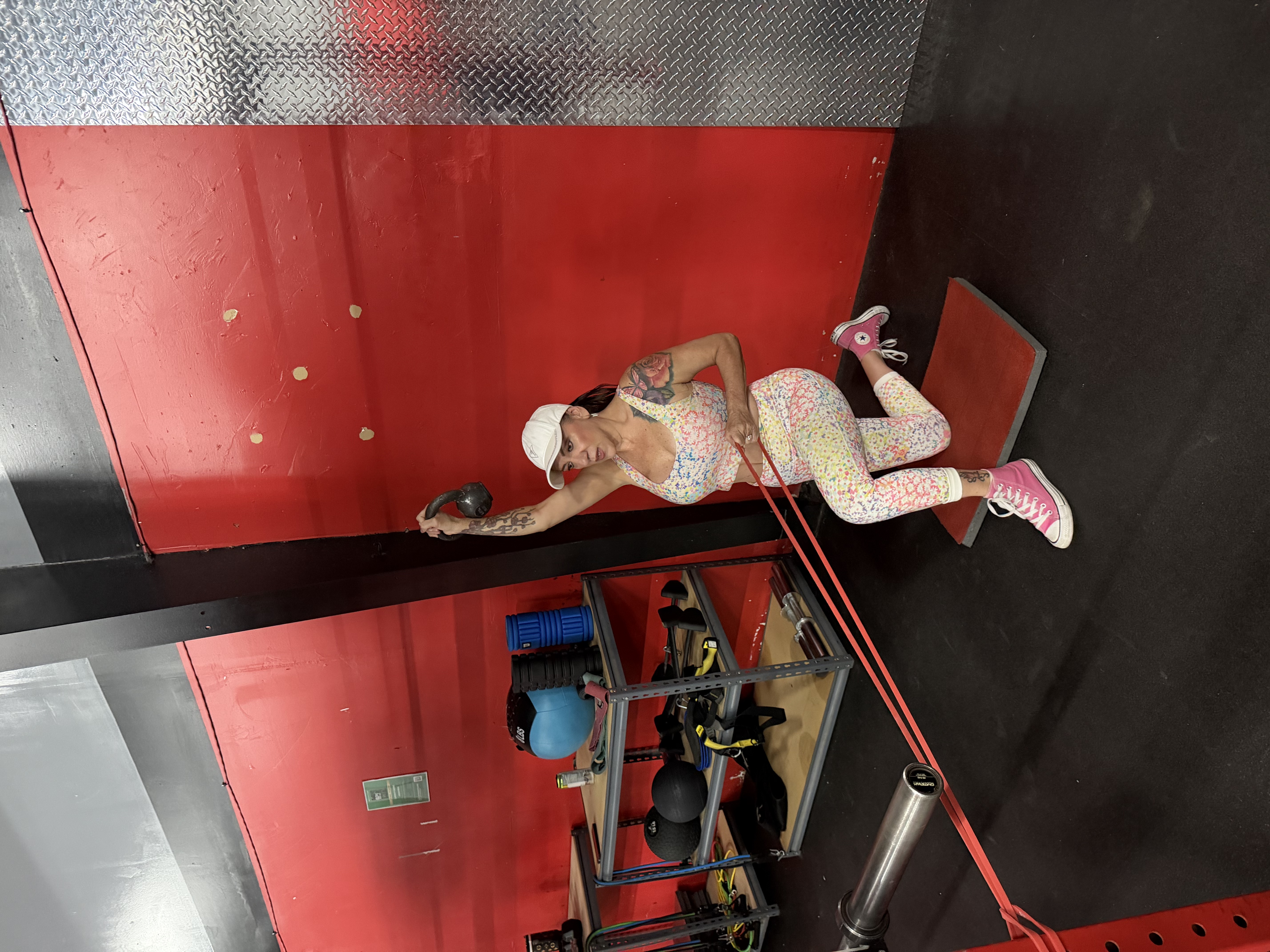
Why a Movement Assessment Matters Before You Start Training
Two people walk into a gym on the same day. Both are 52. Both want to get stronger. One has a stiff right hip from years of sitting at a desk. The other had shoulder surgery a decade ago and still can't reach fully overhead without arching her back.
If they get the same workout, at least one of them is probably going to have a bad time.
That is the simple case for assessing how someone moves before writing their program. Below, we'll look at what research says movement and physical-performance testing can tell us, where its limits are, and how we use a detailed assessment at Peak Life Fitness.
Two kinds of "screening" people mix up
When people hear "assessment," they often think of two different things:
Health screening: Is it safe for you to exercise, and at what intensity? This is about heart, metabolic and kidney health.
Movement assessment: How does your body actually move? Where do you have range, control and strength, and where don't you?
Both matter. They answer different questions.
Health screening
The American College of Sports Medicine updated its pre-exercise screening guidance in 2015. It now focuses on three factors: how active you currently are, whether you have signs or symptoms or a known diagnosis of cardiovascular, metabolic or kidney disease, and how hard you plan to exercise. The panel noted that exercise is safe for most people, and that the older screening approach was sending too many people to the doctor and creating a barrier to getting started.
If you're inactive and have any of those conditions or symptoms, talk with your healthcare provider before beginning a new program.
Movement assessment
This is where a coach looks at how you squat, hinge, lunge, push, pull, rotate, balance and get up and down. It's less about "can you exercise?" and more about "what exercise, how, and where do we start?"
What research says movement testing can predict
Physical performance tests are powerful predictors
Some simple movement tests turn out to say a lot about the future.
In a 1995 study in the New England Journal of Medicine, more than 1,100 adults over 70 with no disability completed a short test of standing balance, walking speed and five chair rises. Four years later, those with the lowest scores were 4.2 to 4.9 times as likely to have developed disability as those with the highest scores, even after adjusting for age, sex and chronic disease. The authors suggested these tests may identify people at an early stage who could benefit from intervention.
A 2011 JAMA analysis pooled data from nine studies and nearly 34,500 adults aged 65 and older. Walking speed was associated with survival in every study. Each 0.1 m/s faster walking speed was linked with a lower risk of death.
These studies were in older adults, but the lesson applies earlier too: how well you move is meaningful health information, not just a fitness detail. And unlike age, it can be trained.
Movement screens and injury prediction: a reality check
Here's where honesty matters. Some popular movement screens are marketed as ways to predict injury. The research doesn't support that use well.
A 2017 systematic review in the British Journal of Sports Medicine looked at 24 studies of the Functional Movement Screen (FMS), a widely used 21-point test. In male military personnel, low scores were linked with only a small increase in injury risk. For soccer, the evidence argued against using it to predict injuries, and for most other groups the evidence was limited or conflicting. The authors concluded that the composite score does not support use as an injury prediction tool.
So no movement screen can tell you whether you'll get hurt. That's not really the point of a good assessment anyway.
What a movement assessment is good for
A detailed assessment is most useful as a starting map for coaching:
Choosing exercises that fit your body today. If your hips don't allow a deep squat yet, you can still train the squat pattern to a box at a height that works, and build from there.
Finding the gaps. Many adults have one side that's noticeably weaker, a limited range of motion at the shoulder or ankle, or trouble balancing on one leg. These are easy to miss in a group workout and easy to address once you know about them.
Setting a baseline. You can't measure progress without a starting point. Retesting shows changes in range, control and strength that the scale never will.
Respecting your history. Past injuries, surgeries and "bad days" for certain joints are all part of the picture.
The National Strength and Conditioning Association's 2019 position statement on resistance training for older adults emphasizes program design that accounts for frailty, sarcopenia and chronic conditions, which starts with knowing where the person is.
There's also a practical payoff. A 2017 meta-analysis found that supervised strength and balance programs in older adults improved strength and balance more than unsupervised ones. Supervision works best when the coach knows exactly what they're looking for in your movement, and that's what an assessment provides.
What to expect in a good assessment
Whether it's at PLF or anywhere else, a thorough movement assessment usually includes:
A conversation about your goals, history, injuries and any medical conditions
Basic patterns: squat, hinge, lunge, push, pull, carry
Mobility checks at key joints like hips, ankles, shoulders and the upper back
Balance and single-leg control
Functional tasks like getting up from the floor and rising from a chair
Notes on side-to-side differences
A plan for how those findings shape your first weeks of training
Body Mapping at Peak Life Fitness
At Peak Life Fitness, every member of our Semi-Private Strength Training program starts with Body Mapping, a two-week process covering about 90 movements. Spreading it over two weeks lets your coach see how your body moves on different days, how you respond to early training, and where you need more attention, rather than judging everything from a single session.
What we learn becomes the foundation of your hyper-personalized program. Coaches work with a maximum of six members at a time, so they can watch your movement closely as your program progresses. Members also get monthly InBody body-composition scans and hyper-personalized nutrition built around foods they enjoy.
Start with a clear picture
If you'd like a program built on how your body actually moves, we'd love to meet you. Schedule a free phone consultation with Jeff or Michelle, or learn more about Semi-Private Strength Training and Body Mapping.
Frequently Asked Questions
What is a movement assessment? It's an evaluation of how you move, including squatting, hinging, balance, mobility and getting up from the floor, used to choose the right exercises and starting point for your training.
Can a movement screen predict whether I'll get injured? Not reliably. A 2017 systematic review of the Functional Movement Screen concluded that its scores do not support use as an injury prediction tool. Assessments are more useful for guiding exercise choices and tracking progress.
Do simple movement tests really matter for health? Research in older adults says yes. Balance, walking speed and chair-rise tests predicted later disability, and walking speed was associated with survival across nine large studies.
Do I need medical clearance before a movement assessment? ACSM guidance bases this on your activity level, any heart, metabolic or kidney conditions or symptoms, and how hard you plan to exercise. If any apply to you, check with your healthcare provider.
What is Body Mapping at PLF? It's a two-week assessment of about 90 movements that starts our Semi-Private Strength Training program and shapes each member's personalized plan.
Sources
Riebe D, et al. Updating ACSM's recommendations for exercise preparticipation health screening. Med Sci Sports Exerc. 2015;47(11):2473-2479. https://doi.org/10.1249/MSS.0000000000000664 (PubMed: https://pubmed.ncbi.nlm.nih.gov/26473759/)
Guralnik JM, et al. Lower-extremity function in persons over the age of 70 years as a predictor of subsequent disability. N Engl J Med. 1995;332(9):556-561. https://doi.org/10.1056/NEJM199503023320902 (PubMed: https://pubmed.ncbi.nlm.nih.gov/7838189/)
Studenski S, et al. Gait speed and survival in older adults. JAMA. 2011;305(1):50-58. https://doi.org/10.1001/jama.2010.1923 (PubMed: https://pubmed.ncbi.nlm.nih.gov/21205966/)
Moran RW, et al. Do Functional Movement Screen (FMS) composite scores predict subsequent injury? A systematic review with meta-analysis. Br J Sports Med. 2017;51(23):1661-1669. https://doi.org/10.1136/bjsports-2016-096938 (PubMed: https://pubmed.ncbi.nlm.nih.gov/28360142/)
Fragala MS, et al. Resistance training for older adults: position statement from the National Strength and Conditioning Association. J Strength Cond Res. 2019;33(8):2019-2052. https://doi.org/10.1519/JSC.0000000000003230 (PubMed: https://pubmed.ncbi.nlm.nih.gov/31343601/)
Lacroix A, et al. Effects of supervised vs. unsupervised training programs on balance and muscle strength in older adults: a systematic review and meta-analysis. Sports Med. 2017;47(11):2341-2361. https://doi.org/10.1007/s40279-017-0747-6 (PubMed: https://pubmed.ncbi.nlm.nih.gov/28573401/)
