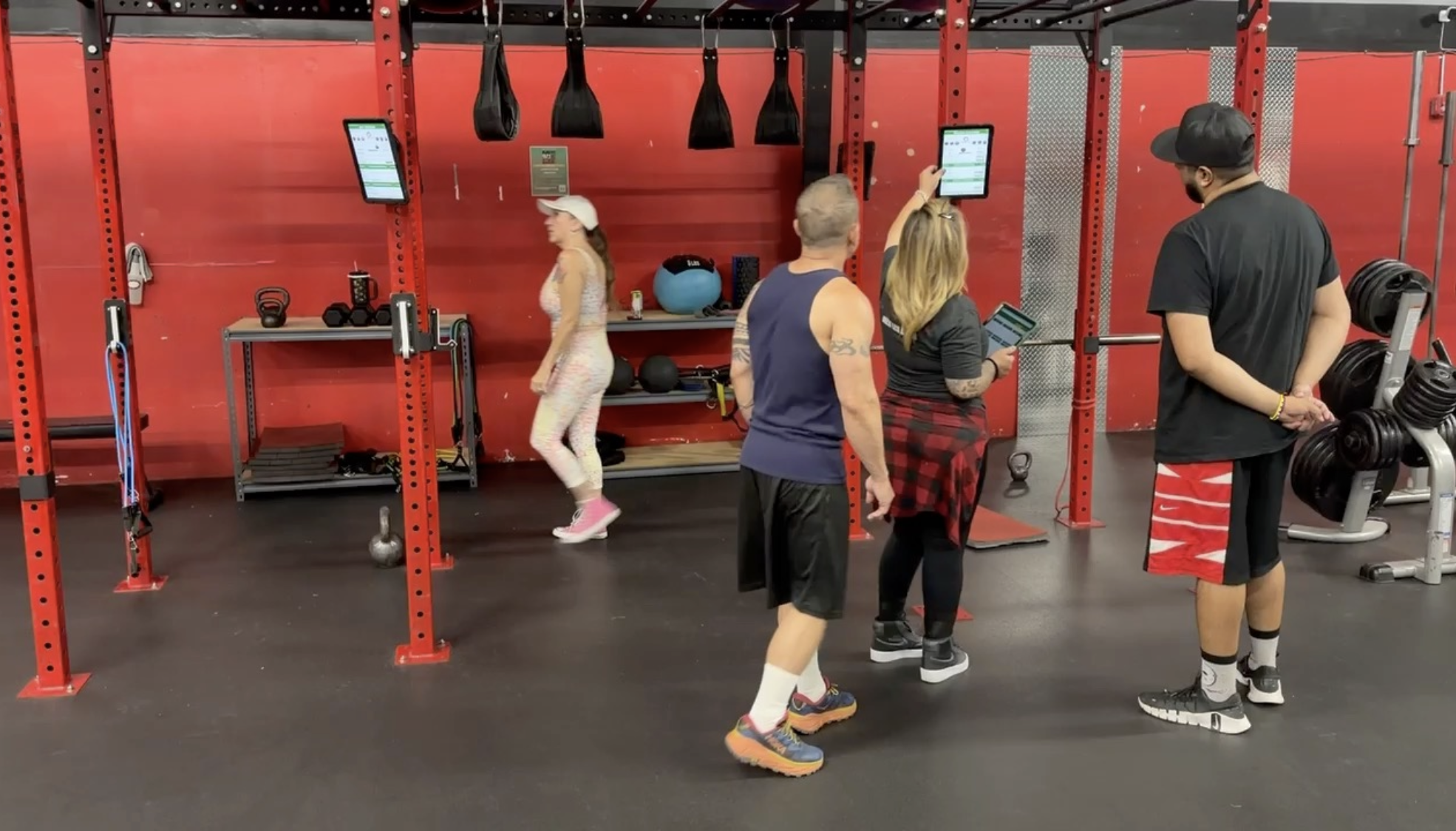
Why Accountability and Community Help You Stay Consistent With Exercise
Almost everyone knows how to start. January gyms are packed. New programs, new shoes, new apps. The hard part is month three, month six, year two, when life gets busy and motivation fades.
Consistency is where results come from, especially after 40, when strength and muscle take steady, repeated work to build and keep. So it's worth asking: what actually helps people keep showing up? Research points to a few things that have little to do with willpower, and a lot to do with the people around you.
Social support: who you start with matters
One of the clearest studies on this comes from weight-loss research. In a 1999 randomized trial, researchers recruited 166 adults either on their own or together with three friends or family members, then gave them a standard behavioral weight-loss program, with or without extra social support strategies.
The differences were striking:
Among people who joined alone and got the standard program, 76% completed treatment, and 24% kept all of their weight loss from month 4 to month 10.
Among people who joined with friends and got the program plus social support, 95% completed treatment, and 66% kept all of their weight loss.
People recruited with friends also lost more weight by the end of treatment and at the 10-month follow-up. Having people in your corner made it far more likely that people finished and kept their results.
Group exercise: connection keeps people coming back
A 2016 systematic review in Preventive Medicine looked at community group exercise programs for older adults lasting six months or longer. Among studies with comparable measures, average long-term adherence was about 69%. When participants were asked what kept them coming, the themes included:
Social connectedness: the people they trained with
Perceived benefits: feeling and seeing the difference
Program design
Feeling empowered and energized
The instructor
The evidence base was small, and the authors called it limited. But the message from participants was consistent: the relationships and the coach mattered.
Is group training always better than training alone?
It's fair to be honest here. A large 2026 meta-analysis in Nature Human Behaviour compared individual and group-based physical activity programs across 71 studies. Group programs showed small advantages for activity levels, psychosocial outcomes and health, but most of those differences were not statistically significant. Group programs did show a small, significant advantage for functional outcomes like strength and flexibility (after outlier removal). The authors concluded that both individual and group approaches can be effective.
In other words, community is a powerful tool, but it isn't the only one. The best setup is the one that keeps you consistent. For some people that's the energy of a group. For others it's a more individualized program. Many people do best with both.
Coaching and supervision: better results from the same work
There is also good evidence that having a coach present changes outcomes, not just attendance.
A 2017 meta-analysis in Sports Medicine compared supervised with unsupervised balance and strength training in healthy adults 65 and older. Supervised programs produced greater improvements in balance and in muscle strength and power. The advantage was largest compared with programs that had no supervised sessions at all. The authors recommended including supervised sessions in strength and balance programs, for example two out of three weekly sessions. They also noted that the number of studies was small and their quality was moderate.
Why would supervision matter? A coach can:
Make sure you're using good form, so you can progress safely
Push the weight or difficulty when you're ready, and pull it back when you're not
Adjust exercises around old injuries, stiff joints or limited mobility
Notice when you've been missing sessions and check in
Self-monitoring: what gets tracked gets attention
Accountability isn't only about other people. It's also about seeing your own progress. A 2011 systematic review in the Journal of the American Dietetic Association found that self-monitoring of diet, exercise and body weight was consistently linked to weight loss in behavioral programs, though the authors noted the quality of evidence was limited.
Tracking works best when it measures what you actually care about. On the scale, progress can stall even while you're losing fat and gaining muscle. Body-composition tracking, strength numbers and how everyday tasks feel give a much fuller picture. (We covered why the scale doesn't tell the whole story in an earlier post.)
Putting it together: how to build accountability into your week
Schedule it like an appointment. Pick specific days and times and treat them as fixed.
Train with people. A class, a training partner or a small group gives you a reason to show up when motivation is low.
Work with a coach. Supervision improves results, and a coach notices when you drift.
Bring someone with you. The 1999 study suggests starting with friends or family can make a big difference in sticking with it.
Track what matters. Strength, body composition and how you move, not just weight.
Expect off weeks. Consistency isn't perfection. It's coming back after the missed session.
How Peak Life Fitness builds accountability in
Our Large Group Training is coach-led, structured and built around community. You train alongside other members, and the coach guides the session and helps you work at the right level. Sessions run Monday through Thursday at 4, 5, 8 and 9 AM and 5 and 6 PM; Fridays at 4, 5, 8 and 9 AM and 5:30 PM; and Saturdays at 8 and 9 AM.
If you want a more individualized approach, our Semi-Private Strength Training offers hyper-personalized programming with a maximum of six members per coach. Every PLF program includes unlimited Large Group and unlimited Semi-Private Strength Training, so you can use both.
Ready to stop starting over?
If you've been doing it alone and it isn't sticking, come see what training with a coach and a community feels like. Schedule a free phone consultation with Jeff or Michelle, or learn more about Large Group Training.
Frequently Asked Questions
Does working out with friends really help? In a 1999 randomized trial, 95% of people who joined with friends and got social-support strategies completed the program, versus 76% of those who joined alone with the standard program. Far more of them also kept their weight off.
Is group exercise better than exercising alone? Both can work. A 2026 meta-analysis of 71 studies found small advantages for group programs, but most were not statistically significant. The best choice is the one you'll stick with.
Do you get better results with a coach? In older adults, a 2017 meta-analysis found supervised strength and balance training improved balance and strength more than unsupervised training.
Why do people quit exercise programs? In a review of long-term group exercise programs for older adults, the things that kept people coming back included social connection, feeling the benefits, program design and the instructor.
How can I hold myself accountable? Schedule sessions like appointments, train with others, work with a coach and track meaningful progress such as strength and body composition.
Sources
Wing RR, Jeffery RW. Benefits of recruiting participants with friends and increasing social support for weight loss and maintenance. J Consult Clin Psychol. 1999;67(1):132-138. https://doi.org/10.1037//0022-006x.67.1.132 (PubMed: https://pubmed.ncbi.nlm.nih.gov/10028217/)
Farrance C, Tsofliou F, Clark C. Adherence to community based group exercise interventions for older people: a mixed-methods systematic review. Prev Med. 2016;87:155-166. https://doi.org/10.1016/j.ypmed.2016.02.037 (PubMed: https://pubmed.ncbi.nlm.nih.gov/26921655/)
Kritz M, et al. Individual versus group-based interventions: a systematic review and meta-analysis of physical activity, functional, psychosocial and health outcomes. Nat Hum Behav. 2026;10(6):1109-1121. https://doi.org/10.1038/s41562-026-02429-0 (PubMed: https://pubmed.ncbi.nlm.nih.gov/41986740/)
Lacroix A, et al. Effects of supervised vs. unsupervised training programs on balance and muscle strength in older adults: a systematic review and meta-analysis. Sports Med. 2017;47(11):2341-2361. https://doi.org/10.1007/s40279-017-0747-6 (PubMed: https://pubmed.ncbi.nlm.nih.gov/28573401/)
Burke LE, Wang J, Sevick MA. Self-monitoring in weight loss: a systematic review of the literature. J Am Diet Assoc. 2011;111(1):92-102. https://doi.org/10.1016/j.jada.2010.10.008 (PubMed: https://pubmed.ncbi.nlm.nih.gov/21185970/)
Schedule a free phone consultation for pricing.
Peak Life Fitness • Updated October 12, 2026
